Interpretable Multiphysics Field Optimization Approach for HSPM Machine Based on Deep Reinforcement Learning
摘要
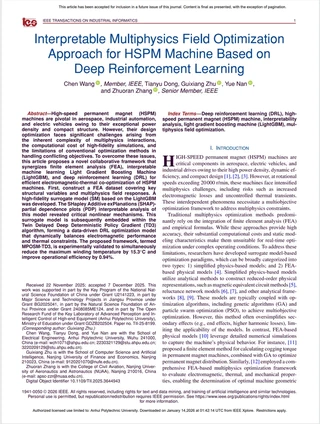
High-speed permanent magnet (HSPM) machines are pivotal in aerospace, industrial automation, and electric vehicles owing to their exceptional power density and compact structure. However, their design optimization faces significant challenges arising from the inherent complexity of multiphysics interactions, the computational cost of high-fidelity simulations, and the limitations of conventional optimization methods in handling conflicting objectives. To overcome these issues, this article proposes a novel collaborative framework that synergizes finite element analysis (FEA), interpretable machine learning Light Gradient Boosting Machine (LightGBM), and deep reinforcement learning (DRL) for efficient electromagnetic-thermal co-optimization of HSPM machines. First, construct a FEA dataset covering key structural variables and multiphysics field responses. A high-fidelity surrogate model (SM) based on the LightGBM was developed. The SHapley Additive exPlanations (SHAP)-partial dependence plots (PDP) interpretable analysis of this model revealed critical nonlinear mechanisms. This surrogate model is subsequently embedded within the Twin Delayed Deep Deterministic Policy Gradient (TD3) algorithm, forming a data-driven DRL optimization model that dynamically balances electromagnetic performance and thermal constraints. The proposed framework, termed MPOSM-TD3, is experimentally validated to simultaneously reduce the maximum winding temperature by 15.3textasciicircumi̧rc textC and improve operational efficiency by 0.94%.
类型
出版物
IEEE Transactions on Industrial Informatics
Analytical Models
Couplings
Deep Reinforcement Learning (DRL)
Density Measurement
Electromagnetics
High-Speed Permanent Magnet (HSPM) Machine
Integrated Circuit Modeling
Interpretability Analysis
Light Gradient Boosting Machine (LightGBM)
Multiphysics
Multiphysics Field Optimization
Optimization
Permanent Magnets
Power System Measurements
Stator Windings